

european commission
Unifying a multilayered archiving infrastructure for the European Commission
Duration of project: February 2020 - December 2020
The challenge and starting point
It would be an understatement to say the European Commission is administratively complex. Thirty thousand staff across countless departments, are producing thousands of legal records per day. Each document must be securely stored for a very specific time period by users who have different level of security clearance and access. All of physical documents had to be manually scanned, then bulk-fed into scan recognition software, and finally digitally archived. A lenghty and a costly process, indeed.
I was brought in to lead the UX research and design, and to help stakeholders understand what is the current process carried out by users, and how this process can be automated via HERMES. HERMES is a a greenfield enterprise records management system acquired by the institution to replace the fragmented, and error-prone, manual process. My role covered the full design lifecycle - from research of current process to ideating the future digital process that will auto-route documents based on combination of user access and document registration number. I was also tasked with providing frequent updates to stakeholders on my findings. The second half of my contract I worked directly with system architects, legal compliance officers, and dev teams to deliver a system architecture.
The brief: Create a single platform to manage digital and physical records. Simplify the user experience without compromising security or compliance. Another unexpected challenge for me was the fact that every decision had to be legally vetted by legal team, which proved to be a blocker that was going to impact deadlines. To mitigate this, I worked closely with legal teams to understand the exact requirements and constraints, and designed a system that inherently complied with legal standards, reducing the need for back-and-forth approvals.
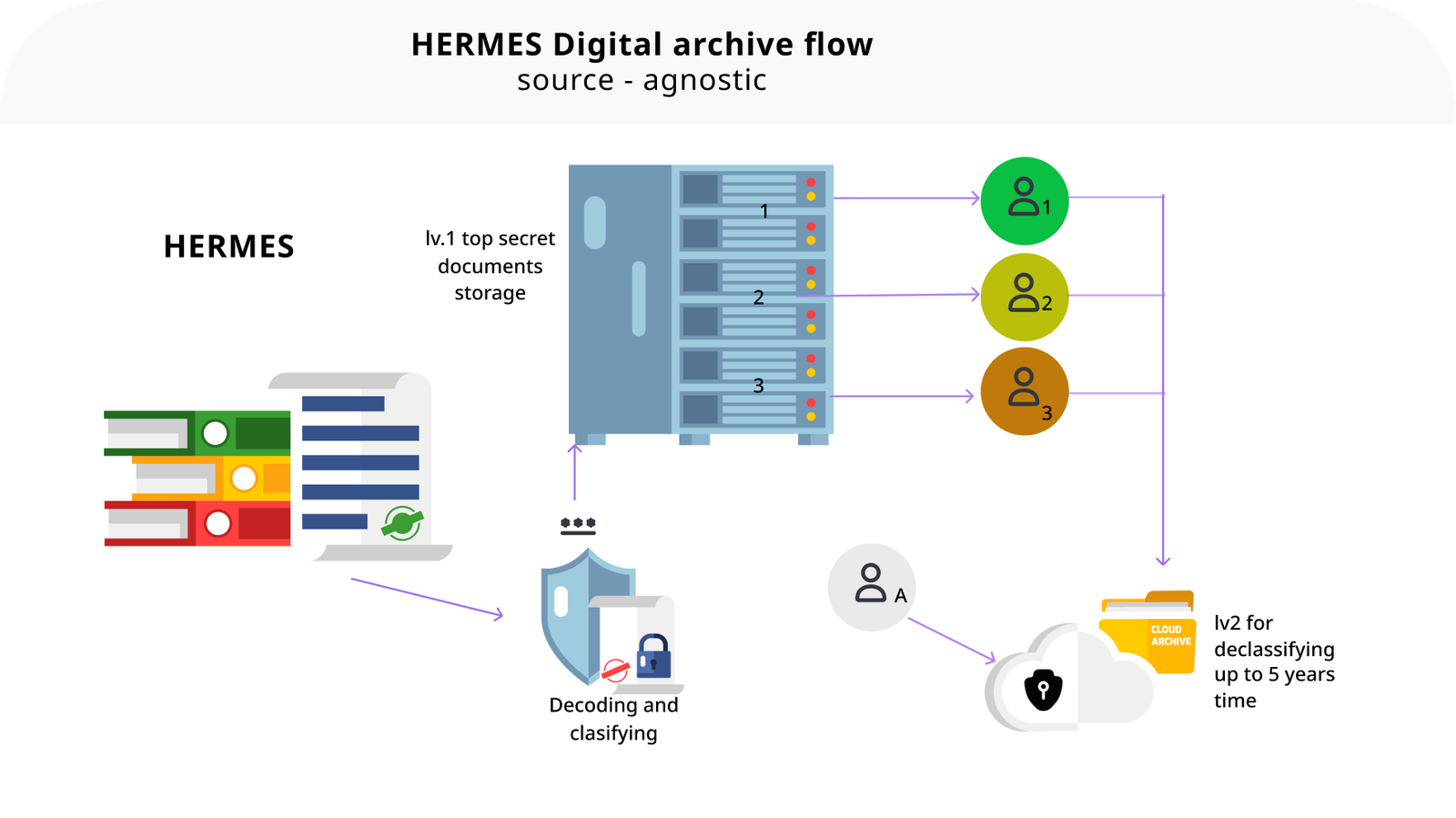
HERMES is an archiving software with web interface created for the European Commission. The challenge was that because of its novelty status I had to learn by myself.
The discovery phase
I embedded with three distinct user groups: junior clerks handling daily correspondence, senior officials managing classified policy documents, and IT and legal teams responsible for compliance and audit trails. European Commission employees had different clearance levels, daily workflows, and risk exposure.
Three problems surfaced in every session.
Security messages on-screen were giving informtion that should not have been visible. Staff regularly hit “Permission Denied” walls and can quickly asses who has permission for what level.
The high volume of coming and going junior clerks meant that many of them would not have proper training in the archiving system, so many documents were archived in the wrong place for the wrong period, and there was no way of tracing these back.
Another issue was the backlog of physical documentation that was piling for digitalizing. Besides the obvious security risk, it was creating a lot of unhappiness among the clerks who had to deal with the backlog, and the senior officials who had to wait for their documents to be digitalized before they could access them.
The Solution and more to be done
The design solution had to be done in such a way so it can prevent clerk errors, at the same time it had to be compliant with legal standards, and it had to be secure enough to prevent data breaches. We used HERMES built in feature to read and recognize the document number upon submitting where documents are automatically routed to the correct digital location based on their registration number and user access level. This reduced the risk of misfiling and ensured that documents were stored in compliance with policies.
High-volume administrative use demanded very optimized and automated solution. I created interface for telephone image-to-text conversion so users now were able to submit their documents immediately and skip the cue.
The Outcome
HERMES is now the live standard for records management across all EU institutions.
The platform rolled out to all employees, after security, Quality and usability tests. The tool drastically improved the user experience and increased efficiency through a single unified interface. Human prone errors were decreased by 90% and the time to archive a document was reduced by 75%. The project gave me unique perspective on exceptionally complex systems. For me to be able to provide a single solution, starting from a single point would require to understand all touch points in the user journey. When designing heavy layered system with 10’s, sometime hundreds of dependancies, a very thorough documentation and reetterative checks were required. It was a great learning curve for me.